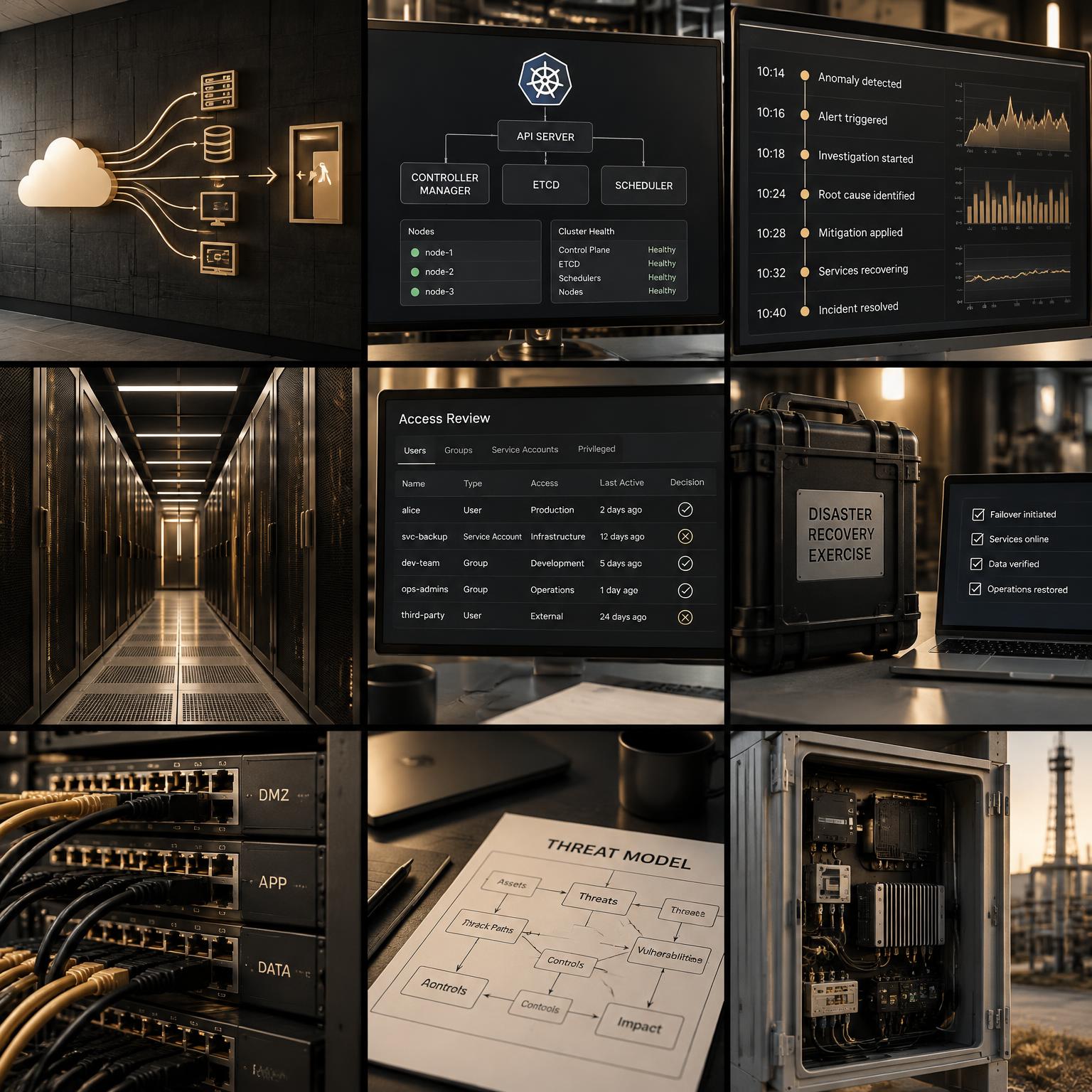
Scope to a boundary
Define the smallest system boundary that still contains the problem, and name what sits outside it.
Scope statement with explicit exclusions

Field & Industrial Services
Integrate sensors, permits and alerts so safety rules are followed and auditable.
Operating position
Work in On-site safety systems is usually inherited rather than designed. Systems accumulate interfaces, exceptions and undocumented behaviour until change becomes expensive. Our first contribution is an honest map of what exists, what it costs and what can safely be removed.
On-site safety systems rewards teams that can prove behaviour, not teams that can demonstrate it once. We build the evidence path — measurement, acceptance criteria, operational ownership — into the engagement so results survive the handover.
Engagement stance
We do not take engagements where the outcome depends on a claim we cannot evidence. If a decision needs a specialist we are not, we say so before contracting.
Signals
Two credible internal positions disagree and there is no shared evidence to settle it.
Vendor claims cannot be tested against your own data or constraints.
Incidents repeat with different symptoms and the same underlying cause.
Ownership of a critical interface is unclear once the original team moves on.
If none of these describe on-site safety systems in your organisation, a short scoping call is usually a better use of time than a proposal.
Landscape
Before any recommendation, we build a shared picture of the ground. These are the six things we examine, in this order.
The physical, regulatory and contractual limits that a plan cannot design around, stated before options are drawn.
Where the numbers come from, how they are transformed and which of them can survive an external challenge.
How a change reaches production today, how long it takes and where it waits.
Named responsibility for each critical component, including the parts currently owned by nobody.
What is measured, what is only asserted, and what would have to be measured to settle the open questions.
What must be true for the engagement to end well, written at the start rather than negotiated at the end.
Method
A typical on-site safety systems engagement moves through five stages. Each stage ends with something you can read, test or hand to someone else.
Define the smallest system boundary that still contains the problem, and name what sits outside it.
Scope statement with explicit exclusions
Put measurement in place first, so improvement can be demonstrated rather than asserted.
Baseline metrics and collection method
Deliver one complete route through the system end to end before widening coverage.
Working path in a real environment
Exercise failure modes, load, recovery and access control against the behaviour production will demand.
Failure and recovery test results
Document runbooks, alarms and ownership, then run the system with your team before stepping back.
Runbooks and a supervised operating period
Questions
Most on-site safety systems engagements start because one of these has no confident answer.
Where is the single point of knowledge that is not written down?
What does this vendor claim, and how would we test it against our own data?
Which constraint sets the schedule — and is it real or inherited?
What does good look like, expressed as a number rather than an adjective?
Who owns this on the day we leave?
What is the cheapest experiment that could prove us wrong?
Capability
Engagements usually begin at one of these layers and move outward only when there is a reason to.
A short, sharp read of technology, team and risk against the decision actually in front of you.
Option sets with consequences, not a single recommendation presented as inevitable.
Working software and infrastructure in your environment, under your review, with your tests.
Documentation written for whoever inherits it, and a handover that is attended rather than emailed.
Outputs
Engagement boundary
What on-site safety systems work covers
What it does not cover
Formats
Any of these can carry on-site safety systems work. Pricing is quoted after scoping; there are no published rates.
45 minutes, no charge
We establish the decision you need to make and whether BELTO is the right party for it. If we are not, we say so and point you somewhere useful.
A written summary of what we heard
Two to four weeks
A bounded, independent read of the current system with a stated method, ending in findings your team can challenge line by line.
Findings document and option set
Scoped per project
Design and build against agreed acceptance criteria, in increments, with evidence attached to each one.
Working system plus handover pack
Fixed term, renewable
Senior engineering alongside your team under your direction, with an explicit objective and an agreed end date.
Delivered work and documented practice
Reading
Published positions, research and technical case studies that inform our on-site safety systems work.
Questions
Next step
Engagements are scoped and quoted individually; there are no published rates. A first call establishes the decision you need to make, the constraint that governs it and whether BELTO is the right party for the work.